
AutoWiki
Your LLM Compiles a Knowledge Base. You Just Read and Ask.
Implementing Karpathy's LLM Knowledge Base vision — raw sources in, Obsidian wiki out.
By AlphaLab-USTC






English · 中文
---
## The Idea
Good survey papers don't just list references — they **identify milestones**, trace how ideas evolved, and organize the field into a coherent structure. AutoWiki does the same thing, automatically.
Drop papers in. The LLM identifies **milestone nodes** (conceptual breakthroughs), clusters papers around them, builds a hierarchical file tree that mirrors the field's structure, and writes deep analysis with temporal links between sources. You get a survey-quality knowledge graph maintained in Obsidian — not a folder of disconnected notes.
```
You drop PDFs LLM compiles You browse in Obsidian
───────────── ────────────────────────── ──────────────────────────────────
raw/new/ → Identify milestones kb/topics/ (milestone nodes)
Cluster papers kb/sources/ (deep analysis pages)
Trace temporal evolution kb/journal/ (cognitive timeline)
Write cross-linked wiki index.md (survey-style tree)
```
---
## 🚀 Quick Start
### 1. Clone & Install
```bash
git clone https://github.com/AlphaLab-USTC/AutoWiki-skill.git
pip install PyMuPDF
```
### 2. Add as Skill
In **Claude Code** or **OpenClaw**, just ask:
```
> "Add /absolute/path/to/AutoWiki-skill/skills to my global skillSources"
```
### 3. Initialize Your Wiki
```bash
cd your-wiki-project
mkdir -p raw/new raw/compiled kb/{sources,topics,journal} output
touch kb/index.md kb/log.md
```
### 4. Start Using
Open the project root as an Obsidian vault, then in Claude Code / OpenClaw:
```
> "Ingest the paper in raw/new/"
> "How does X compare across the Y papers?"
> "Lint the wiki"
```
**Prerequisites:** [Claude Code](https://docs.anthropic.com/en/docs/claude-code) or [OpenClaw](https://github.com/nicobailon/openclaw) + [Obsidian](https://obsidian.md/) + Python 3.12+
---
## How It Works
```
raw/new/ ──→ LLM (Claude Code) ──→ kb/ ──→ Obsidian
you drop reads, analyzes, sources/ you browse
PDFs here links, writes topics/
journal/
```
| Layer | Role | Who owns it |
|-------|------|-------------|
| `raw/` | Source archive (PDFs + figures) | You drop files; agent organizes |
| `kb/` | Living wiki (markdown + wikilinks) | Agent writes & maintains everything |
Three operations: **Ingest** (PDF → analysis page), **Query** (ask questions → synthesize → write back), **Lint** (25+ auto-checks).
---
## What Makes It Different
| | |
|---|---|
| **🧠 Deep Analysis** | Not summaries. CRGP factors from the author's Introduction. Critical analysis with `prior`/`update` contrastive structure. Anti-patterns prevent generic filler. |
| **🔗 Temporal Graphs** | Every source positioned in the field's timeline. Evolutionary chains, cross-domain links, temporal tensions — all automatic. |
| **🏠 Self-Healing** | Three-tier autonomy: **Silent** (fix links) → **Notify** (record insights) → **Confirm** (restructure). 25+ lint checks. |
| **🎯 Smart Classification** | 3-question fitness check before every topic assignment. Auto-scaling: <5 inline, ≥5 split, >8 sub-cluster. |
---
## 📂 Showcase: 80-Paper Wiki
We built a real wiki on **Agent Self-Evolution** — 80 papers, 13 milestones, 2 hours. Here's what the LLM compiled (compiling 80 papers in Claude Code with Opus 4.6 cost ~150 🔪 of quota):
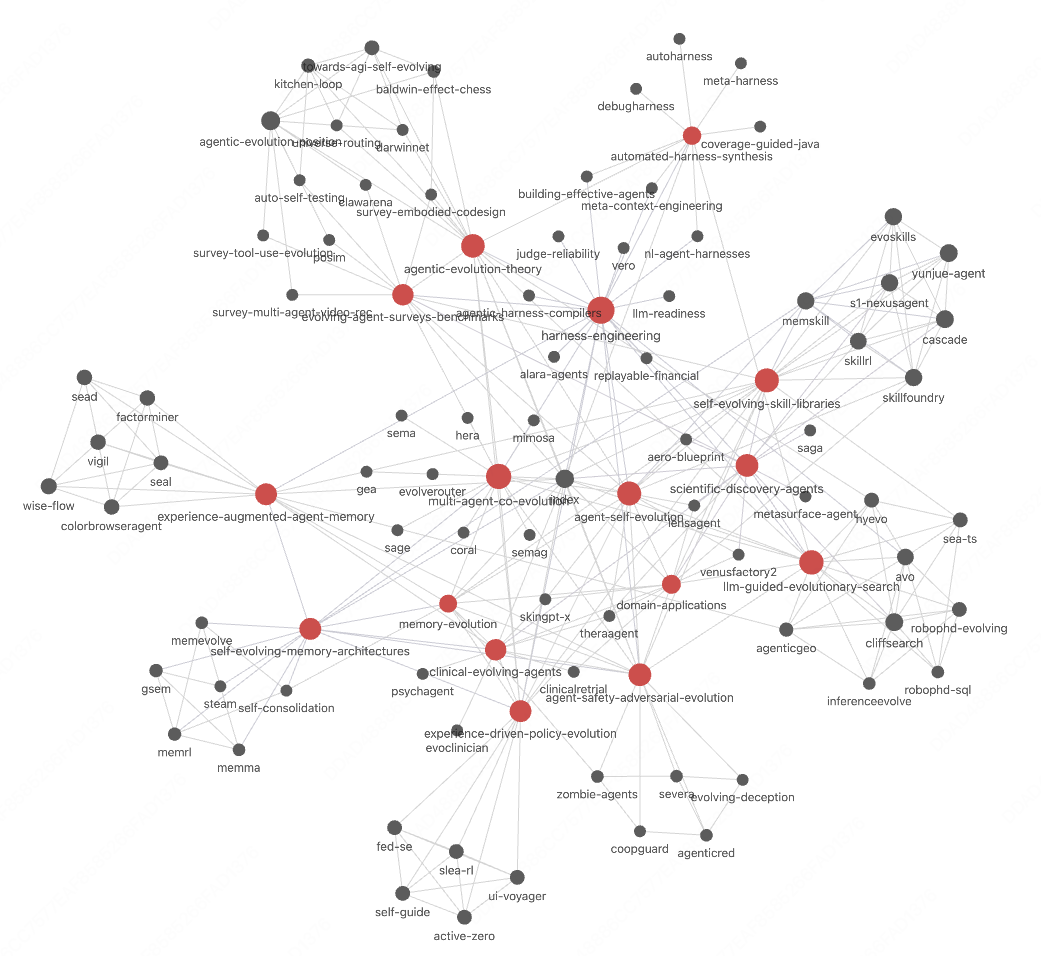
Each node is a source page. Red nodes are milestone topics. Edges are temporal relations (extends, complements, contrasts_with) — all discovered automatically.
### Survey-Style Topic Organization
Each topic is a **milestone node** — like a survey paper, it tells the story of how a research direction evolved.
```
agent-self-evolution (80 papers, 13 milestones)
├─ Mechanism Layer
│ ├─ self-evolving-skill-libraries (7 papers)
│ ├─ memory-evolution (12 papers, 2 sub-children)
│ ├─ experience-driven-policy-evolution (5)
│ ├─ llm-guided-evolutionary-search (8)
│ └─ multi-agent-co-evolution (8)
├─ Application Layer
│ └─ domain-applications (10 → scientific + clinical)
└─ Cross-Cutting Layer
├─ agentic-evolution-theory (6)
├─ agent-safety-adversarial-evolution (5)
└─ evolving-agent-surveys-benchmarks (6)
```
### What the LLM Compiles
| Output | Example | Live Demo |
|--------|---------|-----------|
| **Topic** — milestone node organizing a research direction | agent-self-evolution (80 papers → 3-layer taxonomy) | [**▶ View Topic**](https://alphalab-ustc.github.io/AutoWiki-skill/assets/demo-topic.html) |
| **Source** — single paper deep analysis page | MemSkill (Zhang et al., 2026) — learnable memory skills | [**▶ View Source**](https://alphalab-ustc.github.io/AutoWiki-skill/assets/demo-source.html) |
Topic content preview — agent-self-evolution.md
> **Milestone Definition:** The paradigm of LLM-based agents that autonomously improve their capabilities post-deployment — treating evolution-time compute as a third scaling axis alongside training-time and inference-time compute.
**Synthesis** — Three orthogonal layers:
- **Mechanism** (what/how evolves): skill repertoire, memory system, decision policy, programs/algorithms, agent populations
- **Application** (where applied): scientific and clinical instantiations under real-world constraints
- **Cross-cutting** (theory/safety/eval): conceptual vocabulary, safety constraints, evaluation infrastructure
**Unifying meta-principle:** the "information gap as training signal" pattern — skill libraries exploit skill-augmented vs. skill-free performance, memory evolution exploits memory-rich vs. memory-poor contexts, policy evolution exploits successful vs. failed trajectories.
Source content preview — memskill.md
```yaml
type: source
id: memskill
milestone: "[[memory-evolution]]"
tags: [memory-evolution, year/2026, venue/arXiv]
```
> **one_line:** "MemSkill reframes agent memory extraction from fixed hand-designed operations into a learnable, evolvable skill bank"
**Novel Insight:**
- *prior:* Memory management = content problem, solved with fixed logic (add/update/delete)
- *update:* The extraction procedure is itself a variable — separating "how to remember" from "what to remember" enables joint optimization
**Temporal Relations:**
- `extends` [[cascade]] — same learning principle, different target layer
- `complements` [[skillrl]] — orthogonal skill domains, shared optimization pattern
- `contrasts_with` [[yunjue-agent]] — executable code vs. declarative skills
---
## 💎 The Karpathy Pattern
> *"Using LLMs to build personal knowledge bases… a large fraction of my recent token throughput is going less into manipulating code, and more into manipulating knowledge."* — [Andrej Karpathy](https://x.com/karpathy/status/1911101737498091651)
| Karpathy's Vision | AutoWiki |
|---|---|
| *"Index source documents into directory"* | `raw/` with extracted assets |
| *"LLM incrementally compiles a wiki"* | `kb/` — analysis, synthesis, temporal positioning |
| *"Backlinks, categorizes, writes articles"* | `[[wikilinks]]` + milestone hierarchy |
| *"Obsidian as the IDE frontend"* | Project root = Obsidian vault |
| *"LLM writes and maintains all the data"* | Agent owns `kb/` — proactive write-back |
| *"LLM health checks over the wiki"* | 25+ lint checks |
---
## Why This Architecture?
**Why Markdown?** LLMs work natively with text. No ORM, no migrations. Obsidian renders it beautifully — graph view, backlinks, all for free.
**Why not RAG?** At personal KB scale (~100s of sources), a well-maintained index + grep outperforms vector search. No embedding pipeline needed.
**Why a skill?** `SKILL.md` IS the architecture — 390 lines encoding quality standards, anti-patterns, and workflow rules. No servers, no infra.
---
## 📄 License
MIT — see [LICENSE](LICENSE).
---